The 1875-1881 6d yellow Barbados Britannia stamps can be quite hard to pick apart. Although there were only four stamps, the complexity makes these an interesting area of study.
Background
The contract for the printing of Barbados Stamps moved from Perkins Bacon, who had held the contract from the very first Barbados stamps in 1852, to De La Rue in 1875. The change heralded not only a change of colours for the denominations, but also cleaner printings and different perforations.
The first issue they printed was the 1875 Britannia’s, which came with two different perforations, 12½ and 14. Within this one series there are four separate catalogue numbers for the 6d stamps.
| Value | Year(s) printed | Year released | Colour | Perforation |
|---|---|---|---|---|
| 6d | 1875 | 1875 | Bright yellow (aniline) | 12½ |
| 6d | 1875 | 1875 | Chrome-yellow | 12½ |
| 6d | 1875-1881 | 1876-81 | Chrome-yellow | 14 |
| 6d | 1875-1881 | 1876-81 | Yellow | 14 |
What is Aniline?
Aniline inks were used in stamp production predominantly in the mid to late 1800s, though there are examples of later use as well. It can be reasonable defined as:
“A quick-drying printing ink, typically made with an alcohol vehicle and a pigment…first used in 1869.”
These inks were introduced to combat the problem of cleaning and reuse of stamps that had already been through the post. Early stamps, including the iconic Penny Black, became a target for reuse as people found that the cancels applied to them could be washed off relatively easily. Aniline inks made this process much harder.
Step by step diagnostic
The secret to separation is to follow a simple step by step process which I’ve summarised in the graphic below.
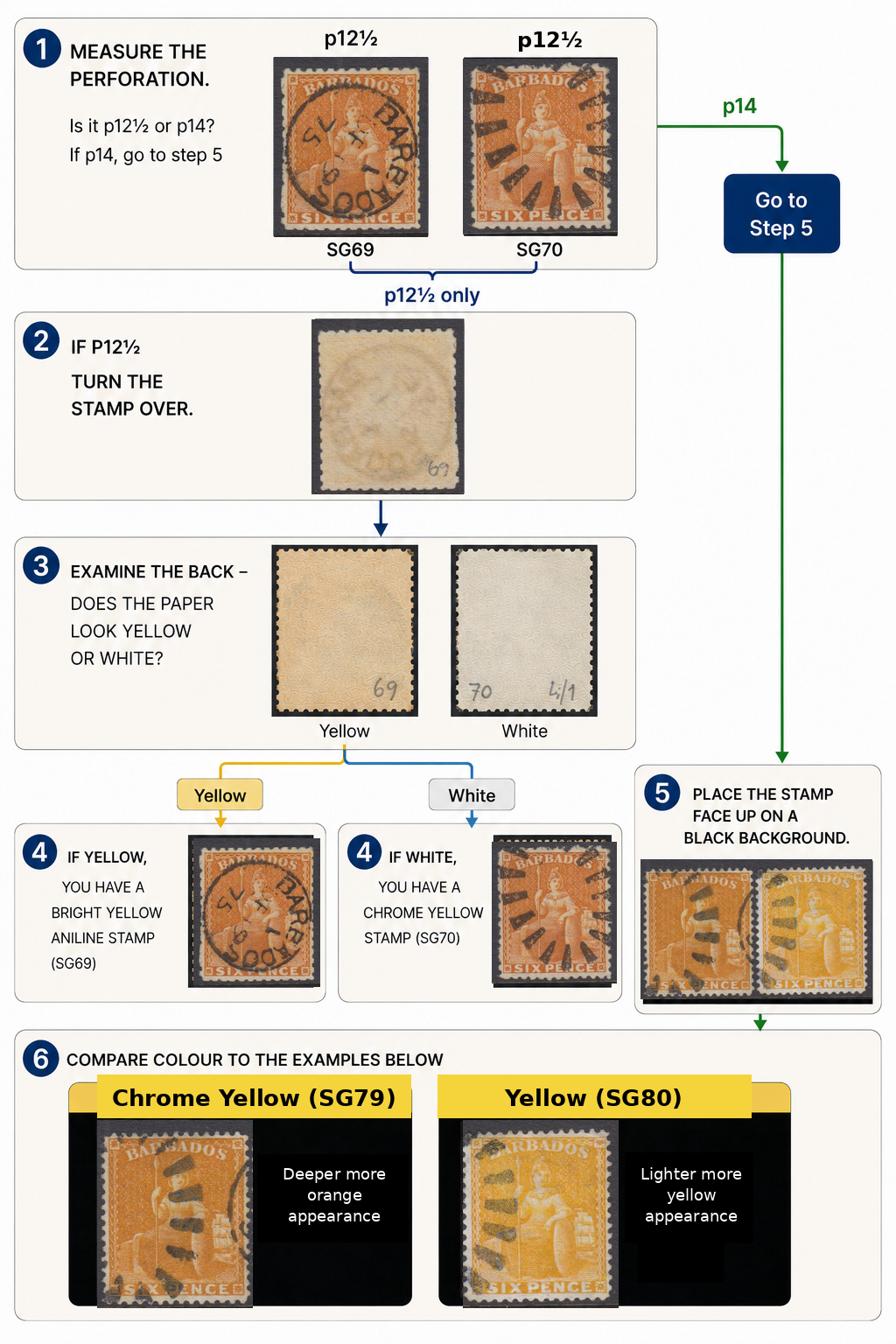
- Step 1 – measure the perforation. Is it p12½ or p14? If p14, go to step 5
- Step 2 – if p12½ turn the stamp over.
- Step 3 – examine the back – does the paper look yellow or white?
- Step 4 – If yellow, you have a bright yellow aniline stamp (SG69), if white you have a chrome yellow stamp (SG70)
- Step 5 – place the p14 stamp face up on a black background
- Step 6 – compare colour to the examples in the diagram
This process means you should be able to regularly pick out which stamp you have with relative ease.
The problem separating the 6d colours
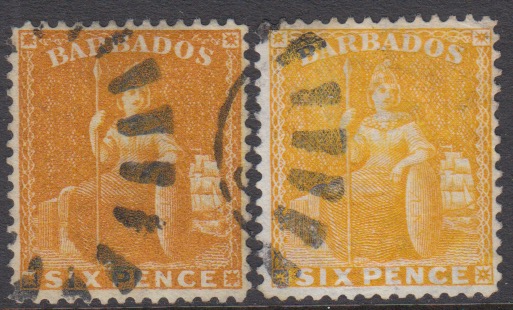
As you can see from the graphic, separating the later 1876 stamps apart should be relatively easy, though in practice you will find that unless you have something to compare with, it still remains a challenge. The best way is to compare them to a known and constants source, such as the excellent book “Barbados – The Britannia Issues” by M Fitz Roett, which has the following image on page 161 to help you separate the p14 stamps.
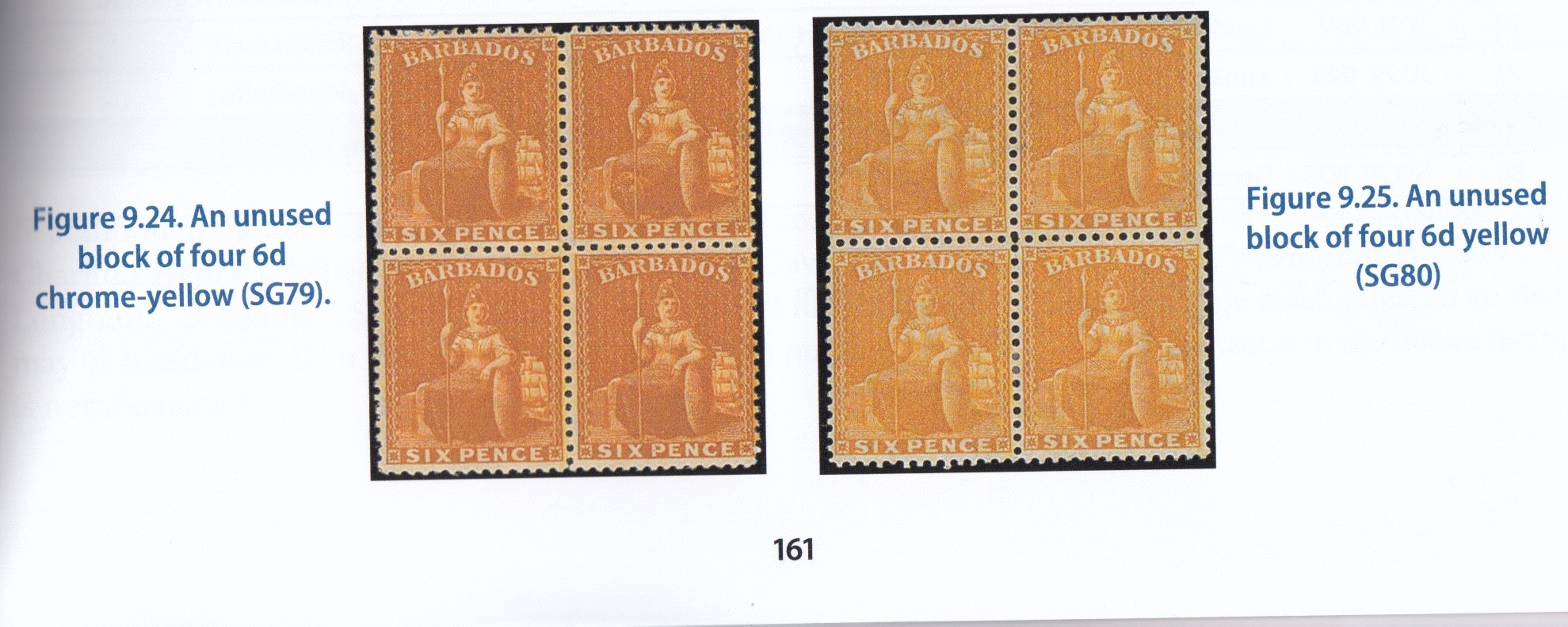
Part of the problem is that between 1875 and 1881 there were no fewer than seven printings of the p14 6d stamps and the printers records don’t differentiate between the two colours shown in the catalogues. Without the precision printing techniques we have today, the colour of these stamps, though ostensibly the same, varied over time.
Similarly, the p12½ stamps, printed and issued in 1875, despite having two distinct catalogue entries (aniline and white), came from just one print run of 26,510 stamps. These p12½ 6d stamps (SG69 and SG70) only differ in that the colour from the ink seeps through to the back of some of the stamps, but not others.
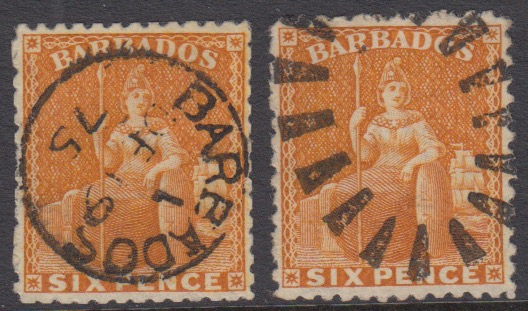
From experience I can say that the bright yellow aniline stamps (SG69) are harder to find than the chrome yellow stamps (SG70), particularly in good condition. Separating them is equally hard as the aniline effect varies across the batch with some being distinctly yellow and others with just a slight yellow hue.
Conclusion
The De La Rue Britannias are a fascinating area of study, only spanning six years between 1875 and 1881 there were a total of 3,516,470 stamps printed and despatched to Barbados. These stamps spanned just six different values (½d, 1d, 3d, 4d, 6d and 1/-) and despite being printed in what was supposed to be just six different colours, ended up spawning catalogue entries for fourteen different shades.
Add to this the laxness of the paper feed into the presses and there are already thirty three different watermark variations to hunt out, along with one of the rarest of all Barbados stamps, the 4d red perforated 14 x 12½ , of which just 20 used and one unused examples are known to exist.
In amongst these, the 6d yellows which have been discussing, contain six watermark varieties to find, if you can first successfully decide which shade of stamp you are holding. Hopefully this article will give you at least a step along the way to identifying whether you have a common 6d stamp or something more interesting.